AI Real Estate Investment Platform
Intelligent property discovery and portfolio analytics with conversational AI
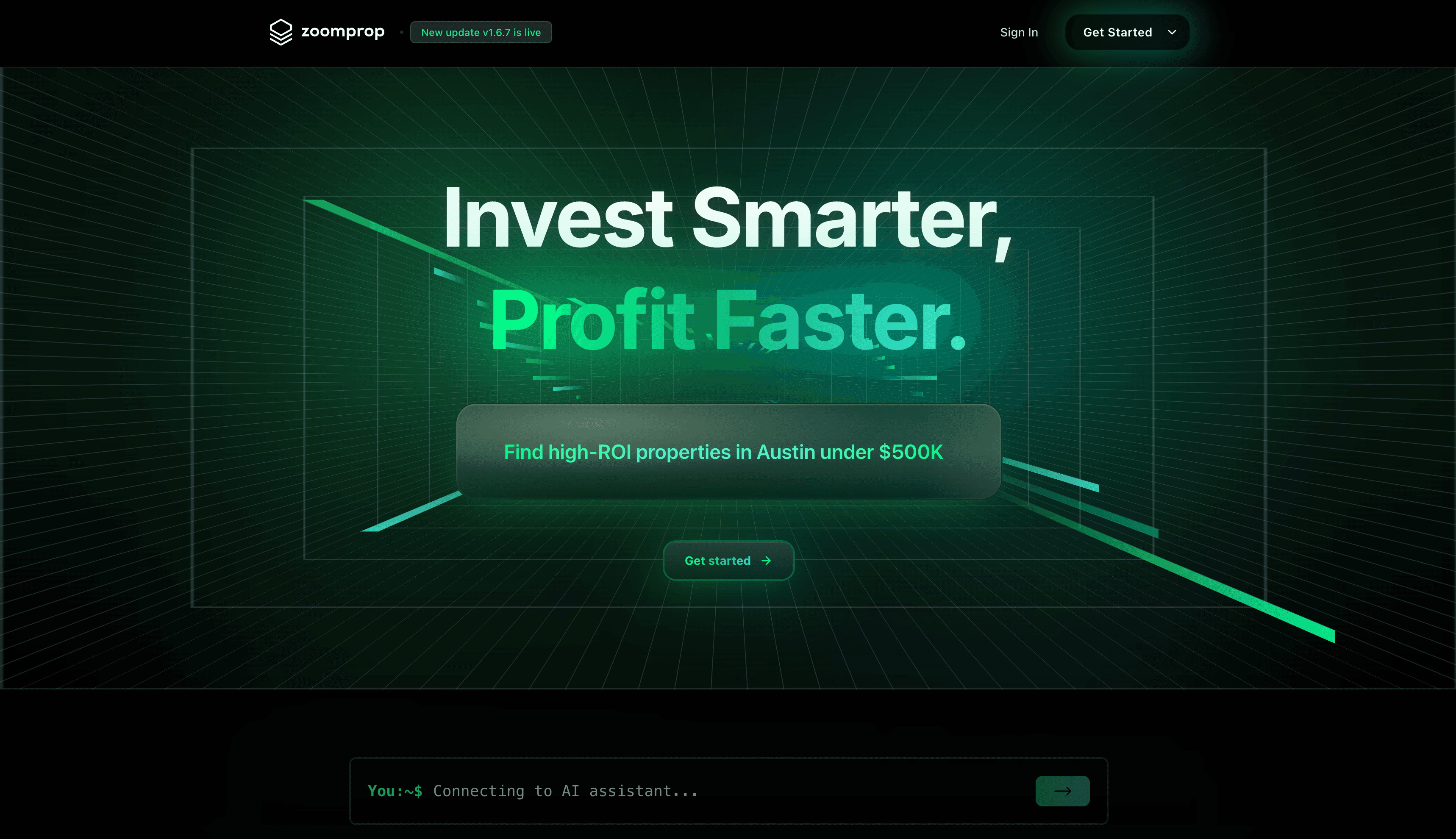
End-to-end (Frontend, Backend, Data Pipeline, Infrastructure)
Real estate investors needed a faster way to discover properties, analyze markets, and make data-driven decisions without manually searching through fragmented data sources.
This platform reimagines how real estate investors discover and analyze properties by combining conversational AI with rich market data. The system enables natural-language queries like 'Show me undervalued properties in growing neighborhoods' and returns actionable insights backed by demographics, market trends, and custom scoring models. Built as a full-stack SaaS with multitenancy, subscription billing, and KYC flows, it handles everything from address normalization to fraud detection at scale.
The Challenge
Traditional real estate platforms require users to filter through dozens of fields, manually cross-reference market data, and jump between tools to get a complete picture. Investors waste time on repetitive research tasks instead of evaluating opportunities. The goal was to build an AI-first platform that could understand investor intent, fetch relevant data in real-time, and present insights conversationally while maintaining accuracy and citation.
Technical Architecture
Frontend
- Next.js 15 (App Router)
- React 19
- TypeScript
- TailwindCSS v4
- Framer Motion
- Mapbox GL
Backend & APIs
- Python (FastAPI)
- OpenAI (GPT-4 + Embeddings)
- LangChain / LangGraph
Data & Search
- PostgreSQL (Supabase)
- Elasticsearch
- pg-boss (Job Queue)
- Redis (Rate Limiting)
Infrastructure
- Vercel (Frontend + Cron)
- Railway (Microservice)
- Fly.io (WebSocket)
- Docker
Integrations
- Stripe (Subscriptions)
- Plaid (KYC/IDV)
- Knock (Notifications)
- Resend (Email)
- Clerk (Auth)
Key Features Built
- Conversational AI chat with streaming responses, function calling, and contextual memory
- Property analysis tools: market trends, offer analysis, maintenance projections, commercial viability
- Watchlist system for tracking properties with bulk CSV import and enrichment
- Address resolution microservice: Elasticsearch-powered fuzzy matching with normalization
- Background job orchestration: pg-boss for async batch processing with retry logic
- Interactive maps: Clustering, heatmaps, region boundaries, and demographics overlays
- Portfolio snapshots: Save and compare investment performance over time
- Subscription billing: Stripe integration with tiered data bundles and usage metering
- KYC flow: Plaid IDV integration for investor verification
- Org-scoped onboarding with progress tracking and automated email reminders (Vercel Cron)
Technical Challenges & Solutions
Address normalization with high variance (abbreviations, typos, missing fields).
Built multi-pass Elasticsearch query with progressive fuzzy matching and confidence scoring.
Slow batch processing for 100K+ addresses.
Implemented parallel job workers with configurable concurrency and backpressure tuning (pg-boss).
AI hallucinations and unsourced claims.
Constrained model to only use function-calling tools, return cited data points, and surface confidence scores.
Map performance with 10K+ markers.
Implemented supercluster for client-side clustering and lazy-loaded region data via viewport bounds.